Archive : Article / Volume 1, Issue 1
- Review Article | DOI:
- https://doi.org/10.58489/2836-2322/005
The Precious Ganoderma Mushroom and Plant Diseases
1Department of Chemistry Natural and Microbial Products, National Research Centre, Dokki, Giza-12622, Egypt
Waill A. Elkhateeb, Department of Chemistry Natural and Microbial Products, National Research Centre, Dokki, Giza, 12622, Egypt.
Waill A. Elkhateeb, Ghoson M. Daba. The Precious Ganoderma Mushroom and Plant Diseases. J. Pharm. Drug. Dev. Vol. 1 Iss. 1. (2022) DOI: 10.58489/2836-2322/005
© 2022 Waill A. Elkhateeb, this is an open access article distributed under the Creative Commons Attribution License, which permits unrestricted use, distribution, and reproduction in any medium, provided the original work is properly cited.
- Received Date: 01-09-2022
- Accepted Date: 13-09-2022
- Published Date: 28-10-2022
Mushrooms; Ganoderma; Plant diseases; Ganoderma boninense; Ganoderma zonatum.
Abstract
The oil palm, an economically important tree, has been one of the world’s major sources of edible oil and a significant precursor of biodiesel fuel. Unfortunately, it now faces the threat of a devastating disease named basal stem rot disease. Many researchers have identified Ganoderma boninense and Ganoderma zonatum as the major pathogens that affects the oil palm tree and eventually kills. Identification of the pathogen causing basal stem rot disease is just the first step. No single method has yet been able to halt the continuing spread of the disease. This review focus on description and lifecycles of two of the major Ganoderma species pathogens on oil palm trees namely G. boninense and G. zonatum. Additionally, we highlighted some possible strategies to control these pathogens and limit the spread of basal stem rot disease.
Introduction
Mushrooms have been used in many sides of human activity for many years. Some of these mushrooms have been called medicinal mushrooms due to their various morphological, physiological, and ecological characteristics that are also responsible for their diversity [1-25]. Some mushrooms and other fruiting bodies of filamentous fungi are edible and provide a good source of protein, whereas others have narcotic effects and used as medicine. Mushrooms contain many valuable secondary metabolites such as fatty acids, polysaccharides, phenolic compounds, and terpenoids [26-34]. Mushroom secondary metabolites especially from Ganoderma (White rot fungus belonging to Basidiomycetes) has been used for medicinal purposes for centuries particularly in China, Japan and Korea. A great deal of work has been carried out on Ganoderma lucidum have different biological activities including, anti-oxidant, anti-viral, anti-inflammatory, anti-coagulate, anti-cholesterol, anti-cancer, antimicrobial activities and other different activities. Mushroom-associated compounds, applied as therapeutic agents such as anti-aging and skin whitening agents. On the other hand, fungi in general and mushrooms in particular are famous producers of different enzymes of industrial applications. Such enzymes have contributed in the efficient role of mushroom in bioremediation and recycling of elements in environment [35-40].
However, Ganoderma has its dark side which can cause major economic loss as it parasitizes on many economic important trees especially oil palm and coconut trees causing basal stem rot disease. Palm oil exports were valued at USD 23 billion in 2017 and USD 21 billion in 2018 [41]. The genus Ganoderma belongs to the family of Ganodermataceae within the Basidiomycetes, which causes white rots of hardwoods in many woody plants by decomposing lignin as well as cellulose and related polysaccharides. In the early stages of decay by Ganoderma spp., bleached zones usually appear in the wood, as a result of selective delignification. Elsewhere within the affected wood, there are less decolorised zones. These remain either relatively intact or show alterations typical of a simultaneous rot. The wood becomes progressively softer as the decay continues. Decay caused by Ganoderma spp. is often limited to the roots and the lower stem. The presence of Ganoderma spp., can usually be detected quite easily due to the development of the perennial fruit bodies. However, there are some species, for instance Ganoderma resinaceum, which form only annual fruit bodies and which can therefore be easily overlooked. The fungal genus Ganoderma is a group of wood-decaying fungi that are found throughout the world on all types of wood; gymnosperms, woody dicots, and palms. [42]. In general, if Ganoderma a basidiocarp (conk) observe on a palm trunk, especially if it is still living, it is probably safe to assume it is Ganoderma zonatum and not some other Ganoderma species. Likewise, the Ganoderma species often observed on hard-wood trees, such as oak, are rarely observed on living palms. These other Ganoderma species may occur on dead [43].
Ganoderma sp. Infect oil Palm at all Stages
Ganoderma sp. is an economically important plant pathogen especially in oil palm, causing basal stem rot disease. The distributions of Ganoderma species are worldwide in green ecosystem both to tropical and temperate regions [44]. The causal pathogen was originally identified as Ganoderma lucidum. In Malaysia, this causal pathogen was first recognised as Ganoderma lucidum [45]. The species Ganoderma has a wide host range, where more than 44 species from 34 genera of plants have been identified as potential hosts. Turner [46] reported fifteen species of Ganoderma from various parts of the world such as North America, Africa, India, Malaysia, Indonesia, Papua New Guinea and Thailand as being associated with BSR, including for example, G. applanatum, G. boninense, G. chalceum, G. cochlear, G. lucidum, G. miniatocinctum, G. pseudoferreum, G. tornatum, G. tropicum and G. zonatum. Within these species G. boninense, G. chalceum, G. lucidum, G. miniatocinctum, G. pseudoferreum, G. tornatum in isolates of diseased oil palms from different areas of Peninsular Malaysia, G. boninense is the most aggressive pathogen to cause the basal stem rot in oil palm [47].
The Ganoderma fungus is a facultative parasite that can live as a saprophyte on rotting stumps and roots, but when a suitable host (Oil palm). Subsequently, the disease spreads from plant to plant by roots or by spores [48, 49]. The bracket fungus, Ganoderma boninense Pat., causes basal stem rot (BSR) disease in oil palm plants (Figure, 1). Previously the disease was reported only in older age palms and currently found on young stages palms as well. Therefore, Ganoderma can infect all stages of oil palm plants. Disease symptoms only appear at the late stage of the disease and usually called a silent killer of oil palm. Progression of the disease is slow; however, it can destroy thousands of hectares of oil palm plantations. Basal stem rot shortens the productive life of oil palms and causes serious economic losses to the oil palm industry. Hence, BSR is considered a serious threat to the oil palm industry in South East Asian countries. To date, there is high demand for sustainable detection and control of this disease. This review paper is elaborated on the detection and ecological impact of Ganoderma and causes basal stem rot disease in oil palms and plantation.
Ganoderma spp. can infect oil palm at all stages, from seedlings to old plants. Disease symptoms progress slowly, but usually every infected plant eventually dies. Usually, the disease develops from the roots but the external symptoms of BSR that appear on young palm shown as one-sided yellowing or molting of lower fronds, followed by necrosis [50]. New leaves become chlorotic, shorter, and the tips sometimes appear necrotic. Older plants when infected develop unopened whitish spear leaves. After a while, foliar symptoms become obvious as the parasitic fungus has already killed about half of the tissues of the plant. The roots of the infected palms are very friable, and their internal tissues become very dry and powdery. The cortical tissue is brown and disintegrates easily, and the stele becomes black in color. Normally, infected young palms die within 6–24 months after these symptoms appeared, whereas mature palms take 2–3 years to die .
Elliott and Broschat, reported that Ganoderma butt rot is caused by the fungus Ganoderma zonatum. This fungus attacks lignin in the position 4–5 feet lower of trunk and the truck appears hard as the fungus does not cause a soft rot. All palms are considered hosts of Ganoderma zonatum. Ganoderma zonatum is not a primary pathogen of any other plant family. Wilting and decline was among reported symptoms and the disease is confirmed by detecting the basidiocarp (conk) on tree trunk before palm death. Basidiocarp is a shelf-like hard structure that appear attached to the lower palm trunk. Although, several diseased palms do not produce basidiocarp prior to death. A palm is diagnosed with Ganoderma butt rot by the formation of basidiocarp on the trunk, or internal discoloration of the trunk is detected after cutting the palm down. Ganoderma zonatum can be spread by spores that are produced then released from the conk. There are currently no cultural or chemical controls for preventing the disease or for curing the disease once the palm is infected.
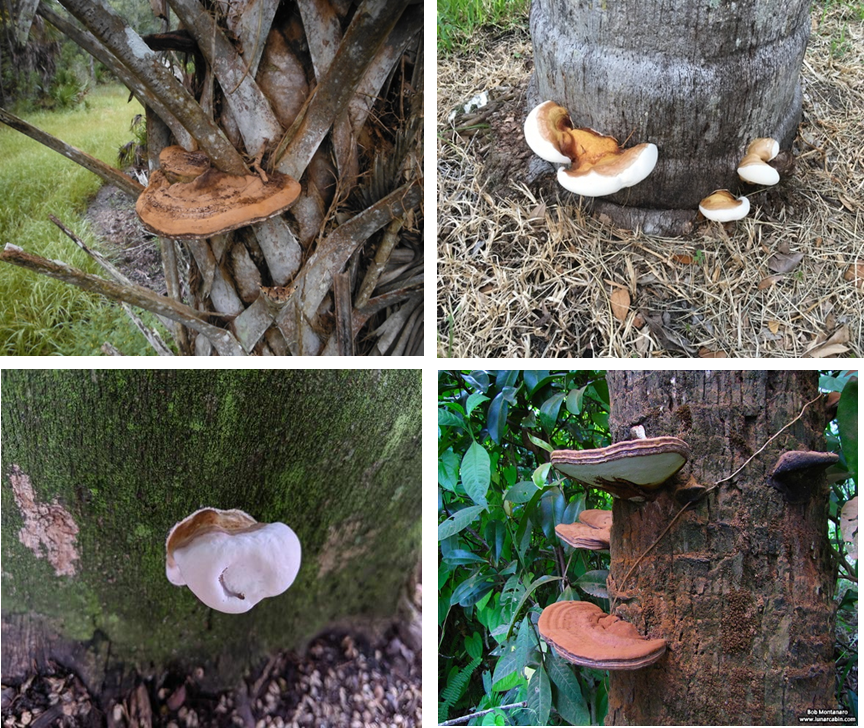
Figure, 1. Different palm trees infected with different Ganoderma zonatum. Cited in: www.srangetracking.com20180823butt-rot-in-palms; www.palmtalk.orgforumtopic70452-ganoderma-butt-rot-advice
Ganoderma Zonatum Description and Life Cycle
Ganoderma zonatum is a white rot macrofungus that produces vast number of enzymes mainly lignin and cellulose that contribute in degrading woody tissue. Ganoderma zonatum is spread primarily by the spores produced in the basidiocarp (conk). The spores become incorporated into the soil, germinate and the hyphae then grow over the palm roots. The fungus does not rot the palm roots, it simply uses the roots as a means of moving to the woody trunk tissue. Once a palm is infected with Ganoderma zonatum, the fungus will move with that palm to the location in which it is transplanted. As the fungus internally degrades the palm wood, the xylem will be affected at the end. Hence, the main symptom that may be detected is a sever to mild wilting of leaves except for the spear leaf. Also, basidiocarp is the remarkable structure associated with the fungus infection as the conk initiates from fungal growth inside the trunk. As the conk matures, a small shelf (bracket) will be formed as the basidiocarp starts to protrude from the trunk. A mature conk will appear in separate zones, hence came the name Ganoderma zonatum. The conk will appear in a half-moon shape with the relatively “straight” side directly attached to the trunk. Ganoderma zonatum basidiocarps, can reach 8 inches (at their widest point) and 2 inches thick. However, conks will take on the shape and size of the area in which they are growing. Basidiospores appear brownish-red and are produced in the pores on the underside of the conk. On the other hand, objects immediately around a conk that has dropped its spores may appear to be covered with a dust that is rusty in colour. One conk can produce 3 cups of spores .
Ganoderma Boninense Description and Life Cycle
Ganoderma boninense was recorded in Asia, Africa, and Central America. On oil palms, G. boninense is recorded from Solomon Islands, Papua New Guinea, Australia and Samoa. Their hosts include oil palm, Albizia, Casuarina, betel nut, coconut, Livistona, and other palms. Nevertheless, it is difficult to specify hosts of G. boninense as different Ganoderma species appear similar. For example, in spite of attacking oil palms, G. boninense can be only identified by molecular methods, and the only method to test pathogenicity of samples is to put an infected rubber wood block under a seedling, and wait for numerous months (Figure, 2).
Symptoms and Life Cycle; In young palms, the lower leaves become yellow or develop yellow/green irregular spots and patches, called a mottle; they bend downwards, and then begin to rot prematurely. The unfolded leaves appear shorter than normal, yellowish in colour, and usually develop rots at the tips. Later, palms become pale and spear leaves remain unopened and growth slows. Similar symptoms were reported on mature palms as they also show numerous unopened spear leaves, and pale leaves. Moreover, dry rots happen internally in stem and bole, and powdery dry rots appear in roots. Within 6-12 months of symptoms appearance, young palms die, while mature palms can survive for about 2-3 years, or longer. The spore-producing structures or 'brackets', technically called 'basidiocarp' continue to form along the trunk, whether the palm remains in place, falls or is felled. They appear brown on top and white on bottom and are about 6 cm or greater. In some southern Asian countries, coconut is also infected by G. boninense causing leaves wilt, nuts become small, and lower leaves rot. Finally, a basal rot develops in the trunk, roots decay, and brackets develop [51].
The life-cycle of Ganoderma boninense is not well known. For instance, how do palms become infected? Is it from root-to-root contact, or from spores produced in the brackets? There is evidence for both. Support for root infections as the cause of basal stem rot comes from (i) artificial inoculations of seedlings, (ii) seedlings planted near Ganoderma-infected trunks in the field become infected the closer they are to the trunks, and (iii) the same is true for seedlings planted near Ganoderma-infected stumps from previous plantings. In these situations, roots become infected when they contact infected soil debris or infected roots. Spores are common in plantations, and so too are wounds made during routine harvesting - leaf bases are trimmed to release the fruit, and bunches are removed by cutting the fruit stalk - so it is possible spores infect oil palms at these times. Coconuts may also be a source of infection for oil palm after the coconuts have been cut down. There is also evidence that coconuts may be infected by Ganoderma boninense while alive but without showing symptoms until they die naturally and produce brackets [52, 53].
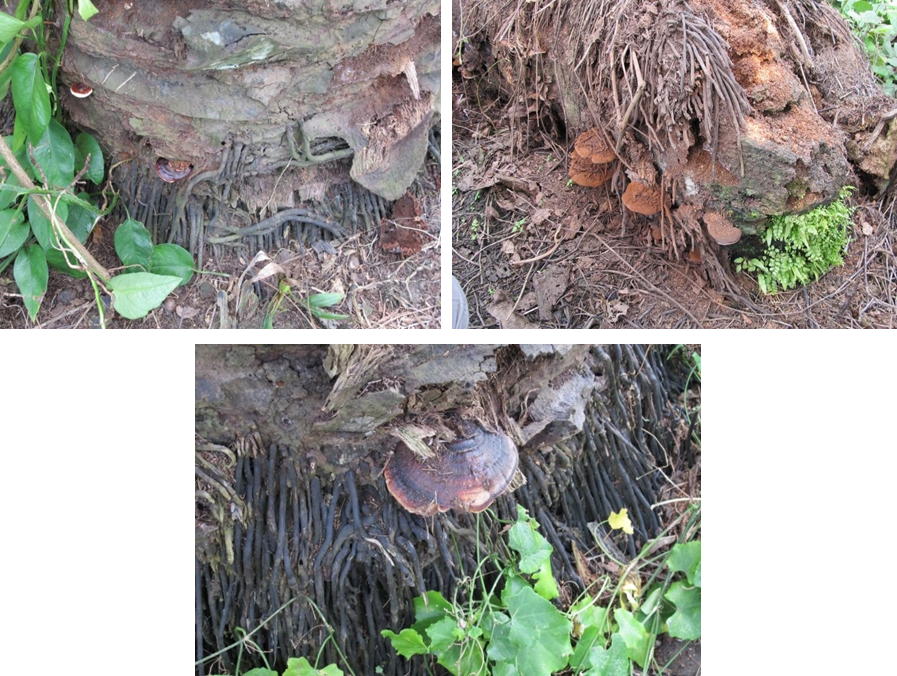
Figure, 2. Different Palm trees infected with Ganoderma boninense.Cited in:
https://apps.lucidcentral.org/pppw_v10/text/web_full/entities/oil_palm_basal_stem_rot_275.htm
Control strategy of the disease
Basal stem rot disease caused by Ganoderma spp., considered most destructive disease in oil palm. This is because the disease escaped the early disease symptoms. Basal stem rot is like a ‘cancer’ in oil palm which is very difficult to detect at the early stages of the disease. In addition, resistant mycelium, basidiospores, chlamydospores, and pseudosclerotia at these resistance stages present in Ganoderma boninense and Ganoderma zonatum which are influence to inhibit control of Ganoderma [54].
Continuous research in combating the problem, the resolution remains stagnant. There are many control strategies for Basal stem rot include physical, chemical and biological procedures. Chemical treatment showed significant reduction in Basal stem rot occurrence when the oil palm trunk was injected with a combination of the fungicides carboxin and quintozene fungicides. However, chemical control agents are not good for the environment since they inhibit the growth of the other good microbes. Hence, growing concerns about the environment and the high cost of chemicals have encouraged farmers and researchers to find out the alternative way to control Basal stem rot, such as the use of biological control agents and pathogen-resistant cultivars.
In vitro studies have shown that the fungi Trichoderma spp., Aspergillus spp., and Penicillium spp. are antagonistic agents towards Ganoderma, (Figure, 3), [55]. When mass produced by antagonistic activity, these antagonists, especially Trichoderma spp., are good bio-control agents for Ganoderma [56]. It is noted that Trichoderma can only protect the plants at the very early stages of the disease, and is not able to cure highly infected palms [57]. Even though, biocontrol agents have not provided a complete solution for Basal stem rot control, but the technique has become a notable approach compared to others. Hence, numerous bio-fungicides are currently available in the market for Basal stem rot control. Using biofungicide is a good agricultural practice for management of plant diseases. The most benefits of bio-fungicide reside in their biocompatibility and biodegradability that it controls the disease without causing any damage to the plant and leaving any toxic [58]. Using biofungicide is a good agricultural practice for management of plant diseases. The most benefits of bio-fungicide reside in their biocompatibility and biodegradability that it controls the disease without causing any damage to the plant and environment [59].
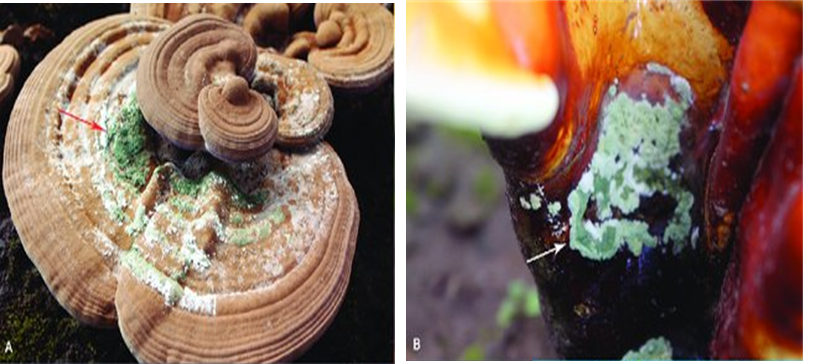
Figure, 3. Green mold Trichoderma species on different Ganoderma fruiting body .
Conclusion
Understanding the economic importance of oil palm and its contribution to world economy has rose a challenge to protect it against pathogens. There is no doubt that Ganoderma is an important medicinal mushroom, but also it causes the disease of oil palm and many other economically important trees. The two species causing majority of loss are G. boninense and G. zonatum. Studying the life cycle of these two species can contribute in finding effective strategies to face this problem with focus on biocontrol approaches. Further studies are required to improve potency of natural biocontrol agents such as the use of Trichoderma species. In order to protect economic importance trees.
References
- ALKolaibe, Abdu Ghalib, Waill A. Elkhateeb, Marwa O. Elnahas, M. El-Manawaty, C. Y. Deng, Wen Ting-Chi, and Ghoson M. Daba. “Wound healing, anti-pancreatic cancer, and α-amylase inhibitory potentials of the edible mushroom, Metacordyceps neogunnii.” Research Journal of Pharmacy and Technology 14, no. 10 (2021): 5249-5253.
- Elkhateeb, Waill, Asmaa Negm ELDien, Eman Fadl, Ali Elhagrasi, Walid Fayad, and Ting Chi Wen. “Therapeutic potentials of n-hexane extracts of the three medicinal mushrooms regarding their anti-colon cancer, antioxidant, and hypocholesterolemic capabilities.” Biodiversitas Journal of Biological Diversity 21, no. 6 (2020).
- El-Hagrassi, Ali, Ghoson Daba, Waill Elkateeb, Eman Ahmed, Asmaa Negm El-Dein, Walid Fayad, Mohamed Shaheen, Riham Shehata, May El-Manawaty, and Ting-Chi Wen. “Malaysian Journal of Microbiology.”
- Elkhateeb, Waill, Marwa Elnahas, and Ghoson Daba. “Infrequent current and potential applications of mushrooms.” In Advances in Macrofungi, pp. 70-81. CRC Press, 2021.
- Elkhateeb, W., M. O. Elnahas, W. Paul, and G. M. Daba. “Fomes fomentarius and Polyporus squamosus models of marvel medicinal mushrooms.” Biomed Res Rev 3, no. 1 (2020): 119.
- Elkhateeb, Waill, Paul Thomas, Marwa Elnahas, and Ghoson Daba. “Hypogeous and epigeous mushrooms in human health.” In Advances in Macrofungi, pp. 7-19. CRC Press, 2021.
- WA, Elkhateeb, and G. M. Daba. “Bioactive potential of some fascinating edible mushrooms Flammulina, Lyophyllum, Agaricus, Boletus, Letinula, Pleurotus as a treasure of multipurpose therapeutic natural product.” (2022).
- WA, Elkhateeb, and G. M. Daba. “Bioactive potential of some fascinating edible mushrooms Macrolepiota, Russula, Amanita, Vovariella and Grifola as a treasure of multipurpose therapeutic natural product.” The Journal of Mycology 5, no. 1 (2022): 1-8.
- Daba, Ghoson. “The endless nutritional and pharmaceutical benefits of the Himalayan gold, Cordyceps; Current knowledge and prospective potentials.” Asian Journal of Natural Product Biochemistry 18, no. 2 (2020).
- WA, Elkhateeb, G. M. Daba, and G. M. Soliman. “The anti-nemic potential of mushroom against plant-parasitic nematodes.” J Microbiol Biotechnol 6, no. 1 (2021).
- Wen, Mohamed NF. “Antiviral Potential of Mushrooms in the Light of their Biological Active Compounds.”
- Elkhateeb, Waill A., Ghoson M. Daba, Marwa O. Elnahas, Paul W. Thomas, and Mahmoud Emam. “Metabolic profile and skin-related bioactivities of Cerioporus squamosus hydromethanolic extract.” Biodiversitas 21, no. 10 (2020): 4732-4740.
- Elkhateeb, Waill A., Ghoson M. Daba, Marwa O. Elnahas, and Paul W. Thomas. “Anticoagulant capacities of some medicinal mushrooms.” ARC J Pharma Sci 5, no. 4 (2019): 1-9.
- Elkhateeb, Waill A., Ghoson M. Daba, Paul W. Thomas, and Ting-Chi Wen. “Medicinal mushrooms as a new source of natural therapeutic bioactive compounds.” Egyptian Pharmaceutical Journal 18, no. 2 (2019): 88-101.
- Elkhateeb, Waill A., and Ghoson M. Daba. “The amazing potential of fungi in human life.” ARC Journal of Pharmaceutical Sciences 5, no. 3 (2019): 12-16.
- WA, Elkhateeb, and G. M. Daba. “Termitomyces marvel medicinal mushroom having a unique life cycle.” Pharm Res 4, no. 1 (2020): 000197.
- Elkhateeb, Waill A., and Ghoson M. Daba. “Mycotherapy of the good and the tasty medicinal mushrooms Lentinus, Pleurotus, and Tremella.” Journal of Pharmaceutics and Pharmacology Research 4, no. 3 (2021): 1-6.
- Elkhateeb, Waill A., and Ghoson M. Daba. “The fascinating bird’s nest mushroom, secondary metabolites and biological activities.” International Journal of Pharma Research and Health Sciences 9, no. 1 (2021): 3265-3269.
- Elkhateeb, W. A., and G. M. Daba. “Highlights on the wood blue-leg mushroom clitocybe nuda and blue-milk mushroom lactarius indigo ecology and biological activities.” Open Access Journal of Pharmaceutical Research 5, no. 3 (2021): 1-6.
- WA, Elkhateeb, and G. M. Daba. “Highlights on the golden mushroom Cantharellus cibarius and unique shaggy ink cap mushroom coprinus comatus and smoky bracket mushroom bjerkandera adusta ecology and biological activities.” (2021)
- Elkhateeb, W. A., and G. M. Daba. “Highlights on unique orange pore cap mushroom Favolaschia sp. and beech orange mushroom Cyttaria sp. and their biological activities.” Open Access Journal of Pharmaceutical Research 5, no. 3 (2021): 1-6.
- Elkhateeb, Waill A., and Ghoson M. Daba. “The wild non edible mushrooms, what should we know so far.” International Journal of Advanced Biochemistry Research 6, no. 1 (2022): 43-50.
- Elkhateeb, Waill A., D. E. El-Ghwas, and G. M. Daba. “Mushrooms and lichens the factory of important secondary metabolites.” Journal of biomedical research and environmental sciences 4, no. 6 (2023): 1072-1082.
- Elkhateeb, W. A., D. E. El-Ghwas, and G. M. Daba. “A Review on ganoderic acid, cordycepin and usnic acid, an interesting natural compounds from mushrooms and lichens.” Open access journal of pharmaceutical research 5, no. 4 (2021): 1-9.
- Elkhateeb, W., M. Elnahas, L. Wenhua, M. C. A. Galappaththi, and G. M. Daba. “The coral mushrooms Ramaria and Clavaria.” Studies in Fungi 6, no. 1 (2021): 495-506.
- WA, Elkhateeb, M. O. Elnahas, P. W. Thomas, and G. M. Daba. “Trametes versicolor and Dictyophora indusiata champions of medicinal mushrooms.” Pharm Res 4, no. 1 (2020): 00019.
- Elkhateeb, Waill A., Marwa O. Elnahas, Paul W. Thomas, and Ghoson M. Daba. “To heal or not to heal? Medicinal mushrooms wound healing capacities.” ARC Journal of Pharmaceutical Sciences 5, no. 4 (2019): 28-35.
- Elkhateeb, W. A., S. C. Karunarathna, M. C. A. Galappaththi, and G. M. Daba. “Mushroom biodegradation and their role in mycoremediation.” Studies in Fungi (2022).
- Elkhateeb, Waill A. “What medicinal mushroom can do.” Chem Res J 5, no. 1 (2020): 106-118.
- Soliman, Gaziea, Waill Elkhateeb, Ting-Chi Wen, and Ghoson Daba. “Mushrooms as efficient biocontrol agents against the root-knot nematode.” Egyptian Pharmaceutical Journal 21, no. 1 (2022): 68-74.
- Thomas, Paul William, Waill Ahmed Elkhateeb, and Ghoson Daba. “Truffle and truffle-like fungi from continental Africa.” Acta mycologica 54, no. 2 (2019).
- Thomas, Paul, Waill Elkhateeb, and Ghoson Daba. “Industrial applications of truffles and truffle-like fungi.” In Advances in Macrofungi, pp. 82-88. CRC Press, 2021.
- Daba, Ghoson Mosbah, Waill Ahmed Elkhateeb, Ting-Chi Wen, and Paul William Thomas. “The continuous story of truffle-plant interaction.” Microbiome in Plant Health and Disease: Challenges and Opportunities (2019): 375-383.
- Zhang, Xiaoling, Xiaojing Zhang, Shuangshuang Gu, Lichao Pan, Huiqing Sun, Enlin Gong, Zhenyuan Zhu, Tingchi Wen, Ghoson Mosbah Daba, and Waill Ahmed Elkhateeb. “Structure analysis and antioxidant activity of polysaccharide-iron (III) from Cordyceps militaris mycelia.” International Journal of Biological Macromolecules 178 (2021): 170-179.
- Elkhateeb, Waill A., Ghoson M. Daba, Asmaa N. El-Dein, Donia H. Sheir, Walid Fayad, Mohamed N. Shaheen, ELmahdy M. Elmahdy, and Ting-Chi Wen. “Insights into the in-vitro hypocholesterolemic, antioxidant, antirotavirus, and anticolon cancer activities of the methanolic extracts of a Japanese lichen, and a Japanese mushroom.” Egyptian Pharmaceutical Journal 19, no. 1 (2020): 67-73.
- Elkhateeb, Waill A., Ghoson M. Daba, Donia Sheir, Asmaa Negm El-Dein, Walid Fayad, ELmahdy M. Elmahdy, Mohamed NF Shaheen, Paul W. Thomas, and Ting-Chi Wen. “GC-MS analysis and hypocholesterolemic, anti-rotavirus, anti-human colon carcinoma activities of the crude extract of a Japanese spp.” Egyptian Pharmaceutical Journal 18, no. 2 (2019): 102-110.
- Elkhateeb, Waill Ahmed, and Ghoson Mosbah Daba. “Medicinal mushroom: What should we know.” International Journal of Pharmaceutical Chemistry and Analysis 9, no. 1 (2022): 1-19.
- Elkhateeb, Waill A., Dina E. EL-Ghwas, and Ghoson M. Daba. “Mushrooms as efficient enzymatic machinery.” Journal of Biomedical Research & Environmental Sciences 3, no. 4 (2022): 423-428.
- Elkhateeb, Waill A., and Ghoson M. Daba. “The wild non edible mushrooms, what should we know so far.” International Journal of Advanced Biochemistry Research 6, no. 1 (2022): 43-50.
- Zhang, Xiaoling, Xiaojing Zhang, Shuangshuang Gu, Lichao Pan, Huiqing Sun, Enlin Gong, Zhenyuan Zhu, Tingchi Wen, Ghoson Mosbah Daba, and Waill Ahmed Elkhateeb. “Structure analysis and antioxidant activity of polysaccharide-iron (III) from Cordyceps militaris mycelia.” International Journal of Biological Macromolecules 178 (2021): 170-179.
- Purnomo, Herry, Beni Okarda, Ahmad Dermawan, Qori Pebrial Ilham, Pablo Pacheco, Fitri Nurfatriani, and Endang Suhendang. “Reconciling oil palm economic development and environmental conservation in Indonesia: A value chain dynamic approach.” Forest Policy and Economics 111 (2020): 102089.
- Schwarze, F. W. M. R., and D. Ferner. “Ganoderma on trees— differentiation of species and studies of invasiveness.” Arboricultural Journal 27, no. 1 (2003): 59-77.
- Elliott, Monica L., and Timothy K. Broschat. “Ganoderma butt rot of palms.” University of Florida IFAS Extension Bulletin 5 (2000).
- Pilotti, C. A. “Stem rots of oil palm caused by Ganoderma boninense: Pathogen biology and epidemiology.” Mycopathologia 159, no. 1 (2005): 129-137.
- Flood, Julie, P. D. Bridge, and Mark Holderness, eds. Ganoderma diseases of perennial crops. CABI publishing, 2000.
- Turner, Peter D. “Oil palm diseases and disorders.” (1981): xvii+-280.
- Wong, Ling-Chie, Choon-Fah J. Bong, and A. S. Idris. “Ganoderma species associated with basal stem rot disease of oil palm.” American Journal of Applied Sciences 9, no. 6 (2012): 879.
- Naher, Laila, Umi Kalsom Yusuf, Ahmad Ismail, Soon Guan Tan, and M. MA Mondal. “Ecological status of’Ganoderma’and basal stem rot disease of oil palms (‘Elaeis guineensis’ Jacq.).” Australian Journal of Crop Science 7, no. 11 (2013): 1723- 1727.
- Sanderson, F. R. “An insight into spore dispersal of Ganoderma boninense on oil palm.” Mycopathologia 159, no. 1 (2005): 139-141.
- Paterson, R. R. M. “Ganoderma disease of oil palm—A white rot perspective necessary for integrated control.” Crop protection 26, no. 9 (2007): 1369-1376.
- Kandan, A., R. Bhaskaran, and R. Samiyappan. “Ganoderma– a basal stem rot disease of coconut palm in south Asia and Asia pacific regions.” Archives of Phytopathology and Plant Protection 43, no. 15 (2010): 1445-1449.
- Rees, R. W., J. Flood, Y. Hasan, Mary A. Wills, and Richard M. Cooper. “Ganoderma boninense basidiospores in oil palm plantations: evaluation of their possible role in stem rots of Elaeis guineensis.” Plant pathology 61, no. 3 (2012): 567-578.
- Chong, Khim Phin, Jedol Dayou, Arnnyitte Alexander, Khim Phin Chong, Jedol Dayou, and Arnnyitte Alexander. “Pathogenic nature of Ganoderma boninense and basal stem rot disease.” Detection and control of Ganoderma boninense in oil palm crop (2017): 5-12.
- Hushiarian, Roozbeh, Nor Azah Yusof, and Sabo Wada Dutse. “Detection and control of Ganoderma boninense: strategies and perspectives.” SpringerPlus 2 (2013): 1-12.
- Susanto, A., P. S. Sudharto, and R. Y. Purba. “Enhancing biological control of basal stem rot disease (Ganoderma boninense) in oil palm plantations.” Mycopathologia 159, no. 1 (2005): 153-157.
- Yan, Yinhui, Chunlan Zhang, Odeshnee Moodley, Lei Zhang, and Jize Xu. “Green mold caused by Trichoderma atroviride on the lingzhi medicinal mushroom, Ganoderma lingzhi (Agaricomycetes).” International Journal of Medicinal Mushrooms 21, no. 5 (2019).
- Badalyan, Suzanna Michael, N. G. Garibyan, and G. Innocenti. “Interactions between xylotrophic mushrooms and mycoparasitic fungi in dual-culture experiments.” Phytopathologia mediterranea. APRIL, 2004 (2004): 1000-1005.
- Abdullah, Faridah, G. N. M. Ilias, M. Nelson, N. A. M. Z. Izzati, and Umi Kalsom Yusuf. “Disease asessment and the efficacy of Trichoderma as a biocontrol agent of basal stem rot of oil palms.” Science Putra (Malaysia) (2003).
- Chung, W. C., J. W. Huang, and H. C. Huang. “Formulation of a soil biofungicide for control of damping-off of Chinese cabbage (Brassica chinensis) caused by Rhizoctonia solani.” Biological Control 32, no. 2 (2005): 287-294.